Centre alumna’s passion project leads to biotech business
Madison Bates '20 loved physics when she arrived at Centre College in 2016.
And she wasted no time becoming fully immersed in the program as a first-year researcher in the lab with Associate Professor of Physics Bruce Rodenborn. She started out recording data on a project that blended macro robotics and fluid dynamics.
"It was fun, and I learned a lot of new skills," she said.
But everything changed when Rodenborn introduced her to the early 3-D printers being used on campus.
"I started tinkering with them, and I found my love for engineering and 3-D modeling," she said. "And from there, Dr. Rodenborn provided me with other research opportunities where I was actually building the robots this time rather than just running them."
In six short years since she completed her degree at Centre, Bates has turned that passion into her doctorate work and a promising business startup that is poised to help doctors better gauge the effectiveness of therapy for those with traumatic head injuries and stroke patients — something that is close to her heart.
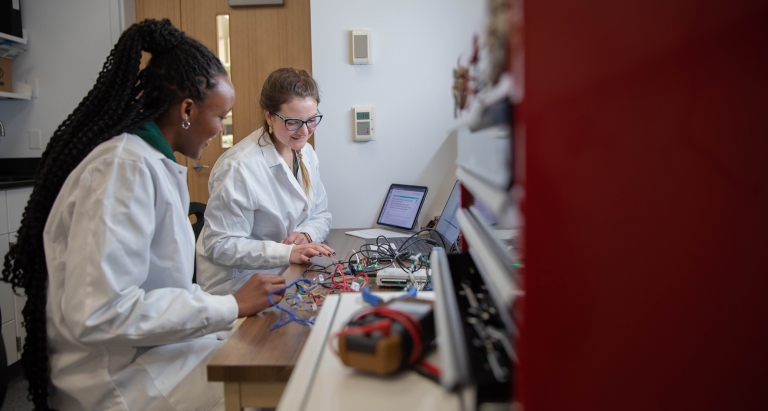
"I tailored my graduate school application to that because I have very personal motivation behind it. My father had a stroke in 2010 and I had seen him struggle through all his therapies, so I really wanted to tailor my work toward helping improve treatments for people like him going through rehab," she shared.
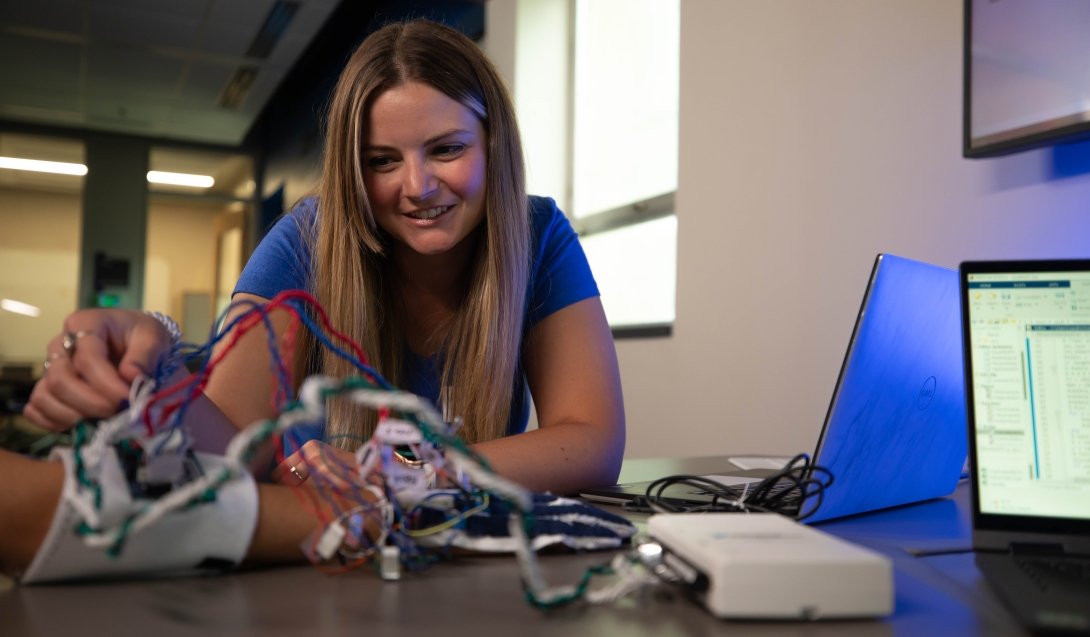
Her advisor at the University of Kentucky College of Engineering guided her toward a project to develop a wearable device that can track hand movement and grip force.
"At the time we didn't realize that it would kind of take a life of its own," she said.
The Halcomb Fellowship
Bates applied for the school's Halcomb Fellowship in Engineering and Medicine, which provides a $30,000 annual stipend (up to 2 years max) for students who advance research designed to benefit patients and the healthcare field.
Among the requirements is to have two mentors in both the college of medicine and college of engineering, which is how Bates connected with Amanda Glueck '10, assistant professor of neurology.
Immediately upon learning about Bates' work, Glueck saw the potential impact such devices could have on her work testing unique rehabilitation aids for people with mild cognitive impairment.
"When Madi's project first came up, she had to sit down and explain it to me because I'm not an engineer, I'm a psychologist," Glueck laughed. "I got really excited because this is a potential way that I can start identifying really small, sensitive improvements you can't necessarily quantify with the technology we have available or the clinical tests we typically do."
Therapists working with rehabilitating patients will evaluate their progress over time. However, these scores can fluctuate and not be very sensitive to small degrees of improvement.
"A lot of our measures that clinicians use are kind of subjective," Glueck said. "Yes, they're trained to be objective, but me rating somebody as a four might be different than what Madi would rate somebody as a four in terms of how well they can perform a certain task."
The real-world ramifications of such assessment limitations can be life-changing, such as insurance companies ending coverage of therapy if a patient is deemed to have reached a plateau in their rehabilitation.
The Device
"What I hope to do with this device is to provide more solid data that's not as subjective or ambiguous for doctors, clinicians and insurance companies and improve decision-making," Bates said.
The wearable creations, dubbed Sensor-E Exoskeleton (SEE), measure both movement and fingertip force, providing objective and quantitative measurements.
"We can shorten therapists' assessment time and increase rehab time and that's critical for stroke patients who are not in the chronic phase," Bates said, "because the faster you administer assessments, the more time can be dedicated to rehabilitation. Thus, increasing your ability to recover."
From Research to Business
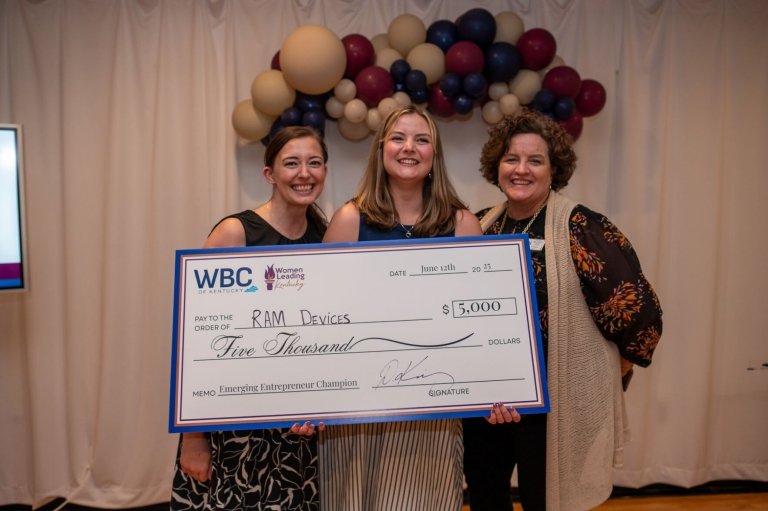
The Halcomb Fellowship prompts applicants to think not just of their research, but also a path to turning that work into a commercially viable product. That led Bates to the Von Allmen Center for Entrepreneurship Bootcamp Accelerator and a series of pitch competition successes and cash awards, culminating in winning the Women's Business Center of Kentucky 2025 Emerging Entrepreneur Pitch Competition, hosted in partnership with Women Leading Kentucky.
"I'm very proud to see Madi's success with all the entrepreneurship work," said Glueck. "She's very modest, but she's been kicking back and taking names, which I think is awesome, especially being a fellow Colonel. We have to celebrate it."
Bates said the pitch competitions have helped her distill her research in a way that makes it understandable to a broad audience.
"I'm learning the entrepreneurial aspect as I go," she said. "Using the building blocks I learned at Centre presenting at the RICE (Research, Internships, and Creative Endeavors) symposiums and presenting in class helped prepare me for grad school and being able to present in front of a bunch of people."
The Centre Foundation
The presentation skills are just one of the ways Centre helped prepare Bates for graduate school, the completion of her doctorate degree in December and her ongoing business venture, Rehab and Assessment Medical or R.A.M.
"Centre allowed me to find myself. I knew I wanted to study physics back in high school, but I didn't really find my career or my passions until Centre," she said. "It wasn't until Dr. Rodenborn showed me the 3-D printers that I was like, 'Oh, this is going to be my new hobby,' and it was something special and I was able to tailor it to my passions in life.
"I'm very fortunate throughout my career that I've had mentors and a support system that has allowed me to continue doing what I love."
Bates wants to pay that support forward if her dreams become reality and her startup grows.
"I love mentoring and that's something I want to do in my company," she said. "Whenever R.A.M. Devices becomes its own little office somewhere, I'm happy to take on Centre students and provide a community to them because Centre provided a safe space and a loving community where you can flourish and not a lot of institutions can say that."