What are Centre students prepared to do? Faculty explain
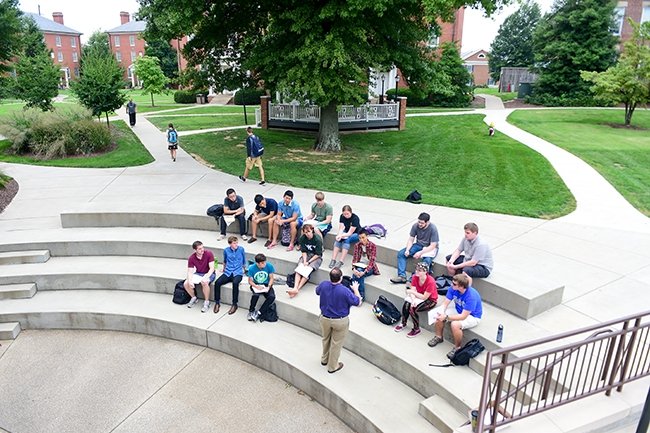
Centre students are ready to enter the workforce or graduate school after they walk the stage at Commencement. That's why 98 percent are employed or pursuing an advanced degree within a year of graduation. But they are also ready for what comes next. Centre's approach doesn't just prepare graduates for their first job, it prepares them for all their future jobs.
How? By drawing from the core principles of the liberal arts to ensure alumni have world-class problem-solving and communication skills, are flexible and adaptable — ready to lead the way forward as the world changes around them.
It's what Centre has been doing for more than 200 years through an approach deeply woven into the fabric of the student experience.
Members of our faculty shared how Centre prepares its graduates for the professional challenges they will encounter.
The future is uncertain — embrace it
By Jamie Shenton, Associate Professor of Anthropology
Last fall, I hosted a career series in which three professionals shared how their anthropology degrees made them more relevant and effective in their roles as a civic designer, a public health scientist, and an entrepreneur of emerging technologies.
While I could talk about how their training as people-centered critical thinkers helped them see and act upon problems in ways that others could not — which it did. What was most surprising to me was the winding nature of their career paths.
One helped find solutions for spatial inequality in her city and directed a consulting firm to help clients rethink their products and services.
Another researched sexual health and served as minister in her church.
The third was once in senior leadership for a system of community colleges and dabbled as a consultant on the history of quantum physics.
These individuals did not always know what they wanted to be. And even holding their current positions, they don't truly know what they will become next.
Saying that the liberal arts are useful for a future career is obviously true. But it's not the whole story, or even the best version of the story.
In fact, a focus on utility obscures perhaps the greatest asset a student gains at a liberal arts institution: a willingness to embrace uncertainty, as the visitors to my class did.
After once deeming the liberal arts "gloriously useless," philosopher Leroy S. Rouner went on to explain himself further: "You can't predict what is going to be useful even if you know what you want to do in the future."
Now, I won't pretend that Rouner will agree with what I am about to say because he was very much pro-learning-for-learning's sake, which seems to not quite fit the brief of talking about the liberal arts and career readiness. But, for him, a lifelong love of learning was the key to success of many kinds, including a lucrative career.
Still, given how quickly the world is changing, none of us knows what will be the problems of next week, much less the problems of the next 40–50 years of our lives — the time most of us can expect to devote to our careers. And, I guess, because we do not know what is going to be useful, none of us really knows where our career paths will lead, either. And if that is the case, the last thing someone needs to be successful is narrow training.
If you only know how to solve one kind of problem, then what happens when that problem does not exist anymore? So, a liberal arts education done well does two things: gives students just enough certainty through specializing in a major so that they are relevant, attractive, and competitive to the employers of the present, and prepares students for an uncertain future that does not yet exist, by requiring them to take diverse classes and try new things.
What a beautiful thing it is to not quite know what we are going to be when we grow up, but be among an elite group of college graduates hired to tackle what we know now and the mysteries that await us tomorrow.
The liberal arts advantage: Learning to decide in a complex world
By Weiss Mehrabi, Assistant Professor of Politics
When students take my courses, most expect to discuss abstract theories and historical events. They still do, but they're often surprised by how quickly ideas become practice.
Students write policy memos, analyze datasets, design international institutions and negotiate crises as diplomats. These are not just academic exercises; they're rehearsals for a professional life that demands analytical rigor, collaboration and comfort with complexity.
Being part of Centre's 2025 Faculty Career Champions Cohort helped me make these connections more intentional. The program asks faculty to translate what we already do in our courses into the language employers recognize. National data show that employers prioritize candidates who possess critical thinking, communication, teamwork, leadership, and technology skills. Also, students believe career development should happen in the classroom, and they look to faculty for guidance on life beyond college.
The cohort helped me honor that trust more intentionally and with greater purpose.
Collaborating with colleagues from biology to fine arts reinforced something I value about the liberal arts. Whether in a lab or a studio, we are working through different pathways toward the same goal — preparing well-rounded graduates who can translate learning into action.
Our work pushed me to better integrate and make these skill-building movements more visible to students. Take my Research Methods course, for example. Students learn STATA, statistical software used by consulting firms, government agencies and graduate programs. They develop original research questions, build theories, collect and clean data, and test hypotheses.
This work mirrors what professional analysts do, but the liberal arts approach goes further: students learn when to question the data itself. One student put it perfectly: "Data tells you what happened, but you still have to figure out why it matters." I see this vividly in my Civil Conflict course, where students examine how women's education shapes the onset of war or how states use artificial intelligence to predict rebellion. They don't just run numbers; they ask hard questions about accuracy, bias, and the ethics of prediction.
This rigorous thinking is paired with practical communication. In my American Foreign Policy class, students acting as a presidential transition team write memos guided by the Plain Writing Act of 2010. They learn that in the professional world, clarity is power. As one student recently noted, "Every word has to earn its place." This mirrors the demands of law schools and government agencies, teaching students rigorous thinking matters, but so does clear writing.
This is where a liberal arts education stands apart. It does not simply teach students how to use specific tools. It teaches professional agility.
Whether they become lawyers, analysts, business leaders, or nonprofit directors, our graduates leave Centre with the ability to think carefully, listen generously, and make informed decisions in a rapidly changing world.
A world of knowledge: Global perspectives bring lasting lessons
By Genny Ballard, Charles T. Hazelrigg Professor of Spanish
A liberal arts education prepares students for career readiness not by narrowing what they do, but by expanding how they move through the world. I see this most clearly when I am with students participating in experiential learning outside the classroom, learning alongside them in real places with real people.
Experiential learning allows students to put lessons into action in a way that exponentially expands the learning opportunities. Not only do they better understand the principles we covered in the classroom, but their work with one another and partners outside the College also requires them to strengthen crucial interpersonal skills that will serve them throughout their careers.
When I took students to Colombia this January, they studied music and dance not as abstract cultural artifacts, but as lived practices. Learning rhythms, movement, and song required deep communication. Our students had to pay attention, listen closely, read bodies and silences, and show respect in spaces where language alone is not enough. At the same time, we saw firsthand the impact of climate change on the Andean environment. Shifting weather patterns, fragile ecosystems, and communities adapting in real time made it clear that environmental decisions are never theoretical. They shape people's lives, livelihoods, and futures.
I have seen something similar when I lived with students in Merida, Mexico. Reading and analyzing texts while sharing meals, routines, and conversations with Mexican host families changes how students think. Interpretation becomes relational. Language is no longer just something you study. It becomes a tool for building trust, navigating differences, and understanding context. Students begin to see how history, place, and daily life shape meaning, and how their own assumptions shift when they slow down and listen.
What stays with students most after they leave Centre are the connections they form, both on campus and abroad. Centre's small classes, close faculty relationships, student groups, and leadership opportunities teach students how to listen, build trust and act with awareness. These skills do more than prepare students for a first job. They inform the decisions students make, the paths they choose, and the kind of leaders and humans they become.
A foundation for the future: Preparing for an AI world
By Amy Frederick, NEH Associate Professor of Art History
The lifelong skills we take away from a robust education in the liberal arts are nearly innumerable. Chief among them is a keen ability to understand, adapt and flourish in a world constantly being shaped and reshaped by technological advancements and discoveries.
Our current relationship with artificial intelligence is complex, intense and ever-changing. It demands flexibility and challenges us to highlight that which makes us human. The skills emphasized in a liberal arts education — especially communication of all types, critical thinking, and creativity — allow us to discern and strengthen our shared humanity, while we learn to use AI tools in intelligent, ethical, and sustainable ways.
The liberal arts are, in fact, the best imaginable partner for a world increasingly shaped by artificial intelligence. At Centre, our emphasis on problem solving, interdisciplinary thinking and cultural awareness can both amplify the positive aspects of AI and reduce its inherent risks.
For example, in one class, we learn about the elements of design so that we can accurately assess the images produced by AI that appear all around us every day. We use those elements as well as AI tools in projects, examining not just how AI can be used, but also if it should be used in the final design.
We examine new uses for AI and interrogate the benefits and drawbacks of these applications for an individual. Students' final project investigates one ethical concern about AI in depth, to understand the impact on various parts of society.
If our humanity remains central to our relationship with AI, we can navigate the future with responsiveness, compassion, good judgment, and wisdom.
Ready for anything: Flexibility and adaptability is at the heart of a Centre education
By Aaron J. Godlaski, Professor of Psychology & Neuroscience
A defining strength of a liberal arts education is not a narrow set of technical skills, but a durable capacity to bring ideas, people and resources into meaningful alignment over time. While specialized programs often train students for clearly defined roles, the liberal arts prepare students to navigate complexity, ambiguity and change.
This preparation begins with disciplined reflection. Liberal arts students are trained to examine assumptions, clarify values and understand how choices are shaped by social and institutional forces. This is not reflection as self-expression, but reflection as orientation: learning how to decide and act when outcomes are uncertain and rules are incomplete.
Equally central is the ability to engage others. The liberal arts emphasize communication, interpretation and perspective taking, all of which are essential when work depends on collaboration rather than individual expertise. Students learn how to translate ideas across audiences, coordinate stakeholders and sustain effort in projects that unfold over time.
Finally, liberal education cultivates an integrative capacity that many forms of training neglect. Students learn to connect learning across courses, experiences and roles, and to find meaning in work that extends beyond immediate tasks. That integrative work fuels motivation, resilience, and ethical responsibility.
In a workplace marked by rapid change and nonlinear careers, these capacities matter more than any single tool or credential. Initiatives such as Centre Spark and its Life Crafting framework make this work visible, but the capacity itself is a longstanding strength of the liberal arts: preparing students not just to enter work, but to shape it.