
Spring 2025 HEDS Survey Results
Introduction
To help understand student perspectives and experiences regarding sexual and relationship violence, Centre College partnered with the Higher Education Data Sharing Consortium (HEDS) in March of 2025 to conduct the Sexual Assault Campus Climate Survey.
Founded in 1983, HEDS is an independent not-for-profit organization committed to sharing data, knowledge and expertise to advance liberal arts education. In 2025, the survey was conducted by 39 institutions, with a total number of 11,049 students completing the survey.
Centre College’s survey results, along with comparative data for other four-year baccalaureate institutions and all other institutions that participated in the survey, are summarized in this report.
Protecting Privacy
To protect the privacy of the students completing the survey, the responses were collected anonymously by HEDS, and the anonymized data was shared with Centre College. Per HEDS policy, a maximum of five members of the institution were allowed access to the complete data set. HEDS excluded all personal information, such as responder name, email address, student identification number and IP address, from the data set provided to Centre.
Additionally, the report does not disclose all data pertaining to race, ethnicity, gender identity, sexual orientation or citizenship, particularly where responses may include multiple identifications.
Details about the survey
For this survey, 276 students provided responses, approximately 20% of the student population in the spring 2025 semester.
|
|
|
|
|
|
|
|
|
|
|
|
|
|
Responses were collected on a five-point scale with the response choices as follows:
- Strongly Agree
- Agree
- Neither Agree nor Disagree
- Disagree
- Strongly Disagree
For the data reflected in the report, answers of “strongly agree” and “agree” were consolidated. Due to rounding, some percentage totals may be slightly less than or exceed 100%.
Campus Climate
The first series of questions intended to address student perceptions of belonging, respect and care at the college.
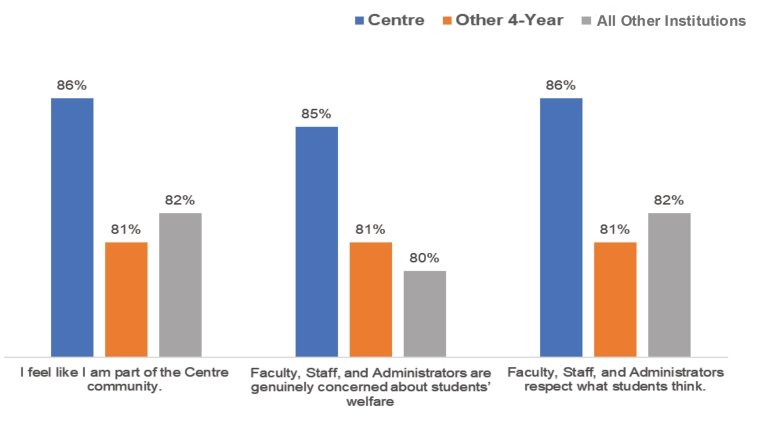
In each instance, positive responses were higher than other four-year institutions and all other institutions.
- 86% of students either agree or strongly agree that they feel like they are part of the Centre community.
- 85% of students either agree or strongly agree that faculty, staff and administrators are concerned about their welfare.
- 86% of students either agree or strongly agree that faculty, staff and administrators respect what students think.
Students reported strong awareness of Centre policies around sexual misconduct overall and were largely more informed about policies than students at other institutions.
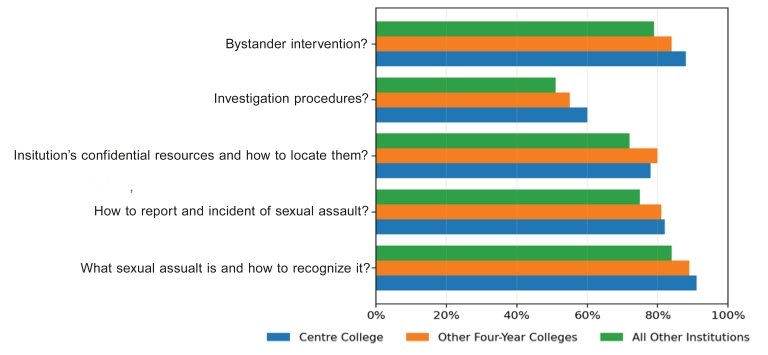
- 88% of students remembered receiving information about bystander intervention.
- 60% of students remembered receiving information about investigation procedures.
- 78% of students remembered receiving information about confidential resources.
- 82% of students remembered receiving information about how to report an incident.
- 91% of students knew how to recognize sexual assault.
Instances of Sexual Assault
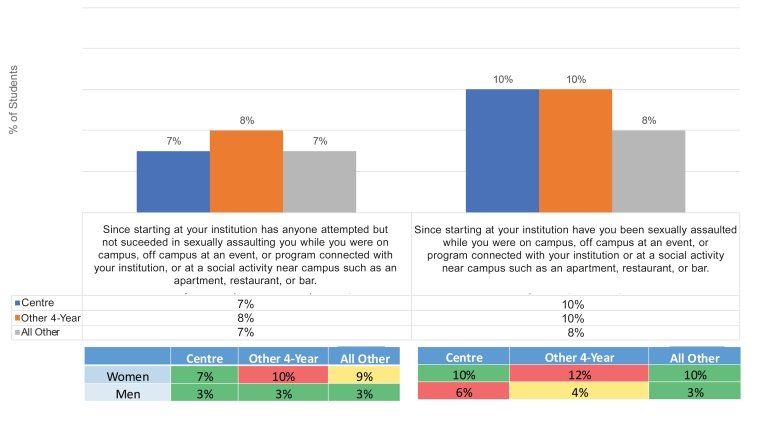
The next series of questions asked students about instances of attempted or completed sexual assault. The survey identified sexual assault as the five following non-consensual behaviors:
- Touching of a sexual nature (kissing, touching of private parts, grabbing, fondling, rubbing up against a responder in a sexual way, even if it was over their clothes)
- Oral sex (someone’s mouth or tongue making contact with responder’s genitals, or a responder’s mouth or tongue making contact with someone else’s genitals)
- Vaginal sex (someone’s penis being put in a responder’s vagina, or a responder’s penis being put into someone’s vagina)
- Anal sex (someone’s penis being put in a responder’s anus, or a responder’s penis being put into someone else’s anus)
- Anal or vaginal penetration with a body part other than a penis or tongue, or by an object, like a bottle or candle
28 students who completed the survey reported that they had experienced a sexual assault, or 10% of the total number of responders. Centre is comparable or lower in percentage of attempted assaults than other institutions. In completed assaults, Centre is slightly higher in the percentage of men who reported that they had been assaulted than other institutions.
Of the 28 students who reported in the survey that had been sexually assaulted the affiliation of the assaulter in these incidents was as follows:
- 89% of the reported assaults were committed by another Centre student.
- 4% of the assaults were committed by a student at another institution.
- 7% of the assaults were committed by someone not affiliated with Centre or another institution.
Of the 28 students who responded that they had experienced a sexual assault, 24 stated that the assault happened between their arrival on campus for orientation and the end of their second year. An additional two stated that they had experienced an assault in both their second and third year. The remaining two said the assault occurred during their third year. None of the students who completed the survey reported that they had experienced an assault in their fourth year.
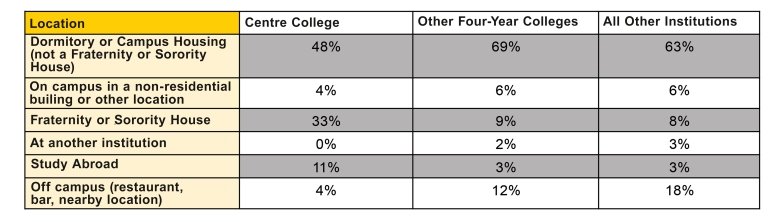
Of the 28 students who responded that they had experienced a sexual assault, they reported a higher percentage of assaults at fraternity or sorority houses, as well as a higher number of assaults during study abroad programs. They reported a lower percentage of assaults in residence halls, non-residential on campus buildings, other institutions, and off-campus locations such as restaurants or bars.
Campus Response
The next series of questions was asked to determine students’ perception of the campus response to a report of sexual assault.
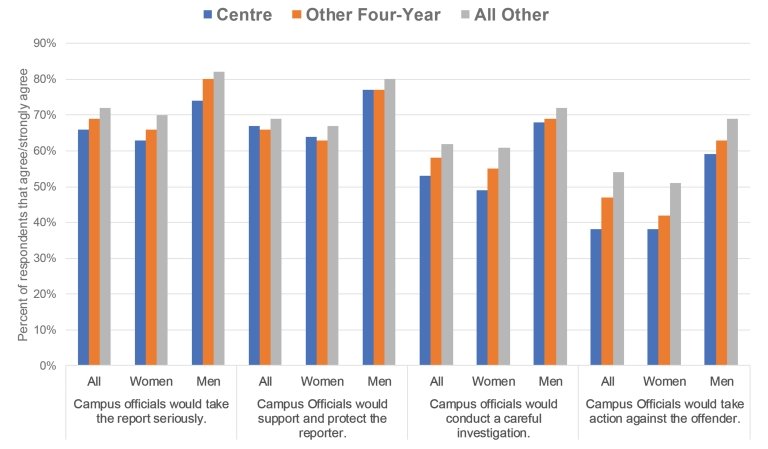
- 65% of students felt that campus officials would take the report seriously.
- 67% of students felt that campus officials would support and protect the reporter.
- 53% of students felt that campus officials would conduct a careful investigation.
- 43% of students felt that campus officials would take action against the offender
In every category, men feel more confident than women in the campus response to reports. In almost every category, students at Centre were less confident in the campus response to reports than students at other institutions.
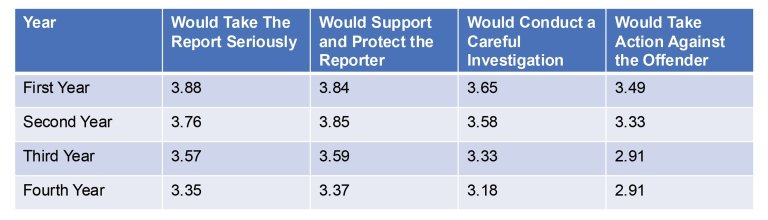
First-years had the greatest confidence in campus response, followed by second-years, then third-years, then seniors.
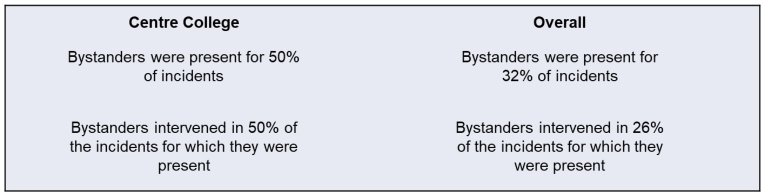
Bystander intervention percentage was higher at Centre than at other institutions.
Summary and Analysis – Campus Climate
Students generally have a positive opinion of the campus climate at Centre, with strong belief that they are part of the community, and that faculty, staff, and administrators are concerned about their welfare and respect what they think. However, there is skepticism in campus officials responding appropriately to a report of sexual assault, particularly that the College would take action against the perpetrator. While this is reflective of a nationwide pattern, it is especially prevalent at Centre.
There are several conditions that may explain this. In 2022, Centre created a dedicated Office for Equal Opportunity & Title IX, which would serve as the central office for Title IX and sexual misconduct processes. Prior to hiring a full-time Title IX Coordinator, there was a period of transition where the role was filled with two interim coordinators provided by a policy firm. Because those coordinators only served for six months at a time and were not located on campus, it may have created confusion for students about the reporting protocol and who to contact for information or concerns. Additionally, due to the lack of presence of full-time Title IX staff, there was not a significant amount of training or programming conducted to inform students about the processes.
As well as these structural conditions, there are also cultural conditions to consider. The small residential campus model creates an environment where information and misinformation can spread rapidly, especially through anonymous social media such as YikYak. Coupled with the an historic lack of regular training about Title IX procedures and the confidentiality of the adjudication process, this can create situations where students may perceive a lack of action without consideration that a situation is reportable, has been reported, that a complainant wished to participate in the proceedings and/or that the process resulted in sanctions.
Summary and Analysis – Incidents
Incidents reported by students in the survey overwhelmingly are violations committed by other students. This is common at most other institutions.
The percentage of reported incidents is lower in our residence halls than at other institutions, particularly interesting considering that almost all Centre students live on campus. Incidents are also lower at off-campus locations compared to other institutions, likely due to the low number of bars, clubs and off-campus residences that students frequent comparatively.
The percentage of incidents that occur during study abroad programs is higher compared to other institutions, which aligns with the fact that over 80% of our students study abroad at least once during their time at Centre.
The most significant difference between Centre and other institutions is that the number of incidents that occur at fraternity or sorority houses is much higher comparatively. A majority of the student-led social events held on campus are parties that are held at the fraternity houses, as opposed to other institutions, where parties may occur at residence halls, bars and clubs, and off-campus student house parties.
The important takeaway from the data regarding the timing and location of incidents is that it informs the College as to the best ways to direct our training, resources, and programming to reduce and prevent future incidents.
Actions Implemented
Centre has taken significant steps, both prior to and following the survey, to make improvements to our policies and programming regarding sexual misconduct prevention and Title IX.
The first steps taken were to create the Office of Equal Opportunity & Title IX Compliance and the Office of Health Promotion. These two offices have provided a network of staff dedicated to prevention, policy and provision of resources. The Title IX Office leads training on sexual misconduct policy, reporting methods and resources available to parties involved in incidents, while the Office of Health Promotion leads training and programming dedicated to prevention and bystander intervention. The offices have a robust partnership and collaborate on trainings and events to reach the campus community. The Office of Health Promotion’s Centre Wellness Advocates also allow for student-to-student interaction and programming that improves buy-in from the student population.
Training programs on campus have also been expanded in scope and content. Beginning in fall 2025, all faculty, staff and administrators now receive biannual training on sexual misconduct policy and prevention, as well as training on how to assist students in distress, helping to ensure that our employees know how to recognize and report issues of sexual misconduct and to provide support to people who may have experienced an incident. The biannual nature guarantees that the training information is up to date regarding policy and best practice. The Title IX Office now participates in an information session for faculty members teaching study abroad courses, providing guidance and resources to assist in prevention and reporting of instances of sexual misconduct that might occur during study abroad courses. More student groups now also receive in-person training on sexual misconduct prevention and bystander intervention, including all athletes, all Greek life members, all resident advisors and first-year mentors, and all incoming first-year students. Online training has been offered to all students on campus. All of these trainings have been modified to include more in-depth information about consent, reporting, confidentiality, investigation processes and sanctions, so that students have the most accurate information regarding Centre’s procedures for addressing incidents when they occur.
Culture of Respect
In December 2023, Centre College joined Culture of Respect, an initiative of the National Association of Student Personnel Administrators (NASPA) designed to assist colleges with tools to strengthen sexual violence prevention and response efforts. Centre was a member of Cohort 8 with 11 other colleges including Butler University, American University and Vassar College. The program lasted for two years, and Centre successfully completed our cohort in December 2025.
The Sexual Misconduct Prevention & Response Committee partnered with student, faculty and staff stakeholders, along with local organizations, to create the Culture of Respect team. This team identified areas where Centre could develop new programming and initiatives to improve the campus culture around misconduct prevention. Many of the changes identified in the actions section were a result of the work of the Culture of Respect team. Additionally, we strengthened our outreach and relationships with community partners such as Ephraim McDowell Hospital, the Danville Police Department, and the Sexual Violence Resource Center of the Bluegrass. In 2024, our revisions and improvements to the Sexual Misconduct Policy included best practices identified through Culture of Respect.
Next Steps
Moving forward, Centre will continue to find ways to improve our trust with the student body. This will include having more participation from the Title IX Coordinator at events and involved in more aspect of campus life, including orientation and move-in for new students, partnerships with more offices on campus, and expanding programming to large student population groups and leadership roles such as athletes, Greek life, residence life, student government, scholarship groups, and clubs. This type of outreach is important both to make the campus community feel more comfortable with reaching out when they need assistance or have concerns, as well as to generate ideas and feedback about policies and processes.
It is also important to use data from this survey to identify areas where targeted outreach and improvements can be made. This will include a broader approach to information access through programming such as training, website improvements, reviewing our reporting processes and ease of access, and additional dissemination of information, such as posters and resource cards. Further, targeted intervention and outreach for younger students who are more likely to experience incidents and expanded resources and outreach at fraternity and sorority houses where a greater percentage of incidents has been identified, as well as additional programming for students who are studying abroad.
Continuation of Survey
Centre College plans to conduct this survey biannually. The next survey date will be Spring 2027.